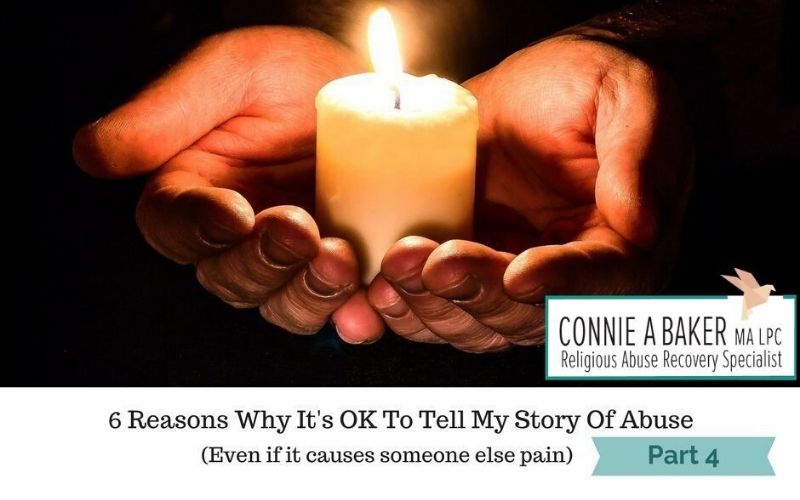
6 Reasons Why It’s OK to Share My Story of Abuse
(Even if it causes someone else pain) Part 3
We have been discussing in this blog series a question very close to my heart and intensely personal. Many of you know that just a few months ago, I posted my story of sexual and religious abuse on YouTube. See it here.
Here was my main concern:
What if people were going to be hurt by the telling of my story??
Not the abuser… but the lives close to the abuser. If I tell my story, who would be impacted and how??
The first reason we discussed was straightforward: (Go HERE to read if you missed it.)
It’s OK to tell my story because if I wait to tell my story until no one is affected, uncomfortable or caused pain, MY STORY MIGHT NEVER BE TOLD.
The second reason was a bit more involved and you can read more about it HERE… it was this: It’s OK to tell my story because it can bring HEALING.
Let’s keep discussing this topic: WHY IT’S OK TO TELL MY STORY EVEN IF IT CAUSES SOMEONE ELSE PAIN.
Today we’ll look at reason #3 and #4.
It’s OK to tell my story because it BREAKS THE SILENCE AND EXPOSES THE SECRETS
- There is an enforced silence surrounding any abuse and it is a primary cause of pain for the survivor – a primary element of the abuse itself. Silence about anything shameful or painful is toxic – silence adds to the pain. It is impossible for abuse to thrive in an exposure. Victims of abuse are often threatened with horrible things if they talk about what is happening to them. Breaking the silence is essential for healing.
- Telling my story validates other survivor’s stories and gives them the courage to break the silence they live in. When survivors hear another person’s story and find their own story reflected in that, it is profoundly validating. Sometimes it gives the extra shot of courage they need to start their own journey of speaking and healing and to bring to light what has been in the dark.
- When I bring the abuse to light it loses its power in me, in other survivors and in society as a whole. Secrets and shame are powerful. When they are exposed, they lose power. It’s a dynamic I see in my office almost daily. The beauty of a publicly told story is that secrecy and shame are immediately weakened – and that goes as broadly as the story is heard! We are seeing that right now with big names being exposed for their rampant sexual abuse.
- Telling my story breaks the isolation of the other survivors and hearers. Isolation is a potent catalyst for pain, personal destruction and (we now know through science) even death. Connection with other human beings I believe is an even more potent catalyst for health, personal growth, and life. When I tell my story, other survivors feel less alone, less crazy, less confused and MORE connected, grounded, sane and aware.
- It is ALWAYS the choice of the survivor who they tell either publicly or privately. No one should be allowed to dictate what another person tells. When someone is abused, the power is taken away from them to speak. If the family or institution connected to the survivor are allowed to determine when and how someone tells their story, it is a re-traumatizing, re-trapping re-abusing dynamic with the power being given once more to the perpetrator and being taken away from the victim. Survivors retain the right to tell their story on their terms.
- It’s OK to tell my story TO BRING AWARENESS
- Telling my story with concrete details helps expose the problem and gives clarity to those who may be going through it. When someone only says they were physically abused, the idea is allowed to remain vague in our minds. We don’t know what that means concretely and we are able to keep more distance from it. When someone says they were tied to a bed a beaten with a stick, we can no longer keep it vague in our hearts and minds. The problem is more real to us. Sometimes people don’t know that being patted on the bottom by a boss is sexual assault – even though they feel horribly violated. Details matter.
- Denial surrounds abusive systems and telling the story breaks the denial. When consistent abuse is allowed to continue in a family, a workplace, a religious institution or in any system, there has to be a lot of minimizing, denying, excusing the abuse and pretending on the part of the people within the system. When people start telling their story, that denial is put under great pressure and sometimes the denial can be broken and truth can surface.
- I will tell my story so that the problem of abuse in all forms (physical, emotional, sexual, spiritual) will become more and more exposed. Interpersonal or social change does not happen quietly, unnoticed or in the dark. The only way oppression in any form has been broken is by clear (and sometimes loud) speech, description, exposure, and action. I tell my story of religious abuse (specifically) because I want to be one more voice of exposure, description and eventual change.
As I write these reasons, I think of my story, my friends’ stories, my clients’ stories, and all the others I have heard…
All. You. Courageous. Survivors.
Know that I am on your team, cheering you on in wherever you are at in your recovery process.
Join me on the next blog to look at what I think are 2 of the most important reasons…

0 Comments